

If you are talking about bad ISO of a crop body and have a strong belief that only full-frame gives better performance…… Then let me know why Canon 5DS/5DSR which is a full-frame body….. Why it starts producing noise even at low ISO like 400? Why it is max out at ISO 3200/6400?
And the answer is….. Pixel Pitch (Pixel Width)….. Higher Mega Pixel makes smaller size pixels which cannot provide sufficient gain over time (G/T) to have better ISO & a sufficient Dynamic Range. The pixel width & depth is not enough to hold more light & they get saturate earlier than expected.
The new trend by all these camera manufacturing companies is to make a full-frame camera body with crop body pixel pitch. It means they have the same old crop body who’s sensor is over 24x16mm size with specific pixel density; they use the same pixel density of a crop sensor and overlay it over 36x24mm sensor and makes a new breed of Mega Pixel Monsters.
Pixel Pitch (Pixel Width) ..... Higher Mega Pixel makes smaller size pixels which cannot provide sufficient gain over time (G/T) to have better ISO & sufficient Dynamic Range.
Let me explain with examples here. It was started with Nikon D7000. Nikon used 16MP sensor of D7000 which was spread over 24x16mm, and then spread the same pixel pitch (pixels per square millimeter) over 36x24mm sensor and made the world first Mega Pixel Star …… Nikon D800/D800E.
This trend was later followed by Canon. They took their 7D MkII which was 20MP machine and enlarged it pixel pitch over full frame and introduced you the world first 50MP machine 5DS/5DSR. But if you look at the ISO performance of the D800 or 5DS, their performance at higher ISO is exactly like D7000 & 7D MkII respectively….. Because they are made on the foundation of a crop body sensor pixel density. Which leads to this interesting fact that the “Gap of Performance” between Full Frame & Crop Body is almost gone. Now both are more or less the same….. Especially if you are talking about higher Mega Pixel machines. Now I am waiting for the Nikon reply for the Canon 5DS/5DSR. If they use Nikon D500 and enlarge it sensor over the full frame area, then we might have 47MP machine….. Or if they use the D7200 for the same purpose, then we will have 54MP monsters under the name of D850/D900.
Below are some old camera in comparison. You can plot the new higher MP machines onto this chart and then you will see some interesting co-relation.
A Gap of Performance between Full Frame & Crop Body is almost gone.
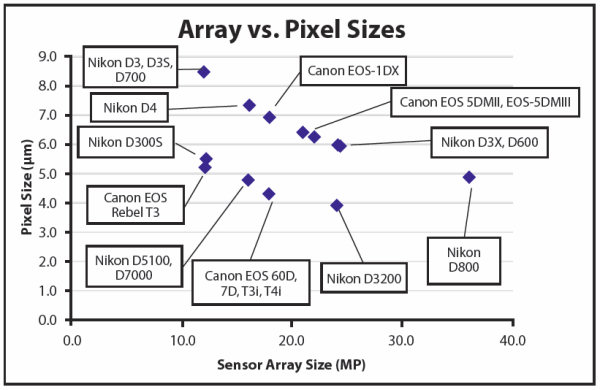
If you look closely above, you will notice Nikon D3200, D600 & D3x all are having the same megapixels. But their pixel size is different. D3200 having 4um & D600/D3x having 6um. The reason is simple, D3200 is crop size sensor body, so the area of the sensor is small, but there are more in quantity, so the effective pixel size has to be smaller, unlike D600/D3x which are full-frame sensor cameras where the sensor size is bigger.
Another interesting fact, if you notice, is that all cameras in the above list and the new ones, their pixel size is not smaller than 4um. The reason is that all these camera companies found out that 4um is the threshold of a pixel pitch where they can have maximum efficiency physically from a silicon wafer of the sensor, which can provide sufficient Dynamic Range and optimum ISO performance. (Note: 4um means around 24MP). Therefore, you cannot see from Nikon or Canon or Sony or Fuji manufacturing any crop body or full frame with pixel pitch smaller than 4um…… In other words, they are not making crop bodies more than 24MP. You may find some machines like 3.9/3.8, but they are floating around 4um. Any camera with less than 4um pixel pitch produces worse Dynamic Range. The best examples are the mobile phone cameras where the pixel pitch is around 1~1.5 micrometers, and their performance is not even close to the DSLR. But due to better SNR firmware, they are doing some really decent job.
Please see below the Dynamic Range chart containing both full-frame and crop sensor which will help you in understanding the relation between Mega Pixels & Range.

Here is another funny thing….. It doesn’t matter what format of camera you are using….. Exposure of any scene always remains the same for all types of camera sensors, it never changes, which means ISO is totally irrelevant then. What matters are the following things,
Aperture of the Lens. Shutter Speed & Pixel pitch (also known as Mega pixels)
All these 3 items mentioned above, in general, knows as “Native Gain.” By adding or subtracting any of above 3 things…. you can have better or worse results. For example, a kit lens with Aperture f/3.5~5.6 not enough to provide better native gain, unlike a prime lens of f/1.4. The same goes for slower shutter speed where you can drag the shutter slow and get more light into the sensor by keeping lower ISO.
Let me share some more example to make a better understanding about Pixel Pitch. Nikon D3/D3s/D700 & Sony A7S/A7SII all are 12MP which means they all are having 8.4um pixel pitch which is exactly double then Canon 5DS/5DSR 4.14um. This means that all machines of Nikon & Sony can handle the low light situation pretty darn well because their sensor got “bigger” eyeballs then Canon. They have the tendency of capturing light more than double & still produces low noise compared to Canon 5DS/5SDR…… and the funny thing is that they all are Full Frame but still 3 performs better than 1….. All because of different pixels sizes and its impact.
Now someone will jump and say “What about ISO?”….. I mentioned this thing multiple times in past that ISO is just an “Applied Gain”. The way you increase the audio in a stereo system, ISO exactly works in the same way. You can change the applied gain in post-processing, but you cannot change the “Native Gain” change in post processing….. That’s why they are Native.
The bottom line is….. This impression that Full Frameworks better in low light & produces less noise….. I just explained in detail above with example that it is not the case anymore. The difference of performance between the full frame camera body & crop sensor camera body is now near to ZERO.
But our life is Never Easy because We are Engaging in this Machine/Brand Rivalry instead of Focusing on Developing our skillset of Photography.
Today’s crop body DSLR is performing far better than the full-frame of the past. The best example is Nikon D500, which is giving you the latitude of ISO performance up to 51,200 ISO, which was unheard 10 years ago. Not even Full Frame released 8~10 years ago can go up to this much ISO… Thanks to the new sensor technology, advanced A/D converter & SNR firmware, which all these camera companies working very hard on and releasing products to make our life easy.
