Hubble Discovers Baby Star 20 Times Larger than the Sun
VUE
September 4, 2023
Home » Blog » Hubble Discovers Baby Star 20 Times Larger than the Sun
The Hubble Space Telescope keeps shining brightly in the world of astronomy. Even with the buzz around the James Webb Space Telescope, Hubble remains a crucial tool for exploring the cosmos and delivering breathtaking images. Hubble recently turned its gaze toward an intriguing subject: OH 339.88-1.26, a protostellar object. These protostars emerge from the gravitational collapse of clouds filled with gas and dust, representing the early stages of star birth. What’s fascinating about OH 339.88-1.26 is that it’s not just any object; it’s an astrophysical maser. Think of it as a natural microwave amplifier emitting radiation. These masers occur naturally in different cosmic settings. Astronomers used Hubble’s impressive Wide Field Camera 3 to examine OH 339.88-1.26.
This object resides about 8,900 light-years away in the Ara constellation. The goal of this study is to gain a deeper understanding of massive protostars and validate theories regarding their formation. The star of the show in this Hubble image is the hefty protostar G339.88-1.26. This young star is still in the process of gathering material from its parent molecular cloud and already weighs in at about 20 times the mass of our Sun,
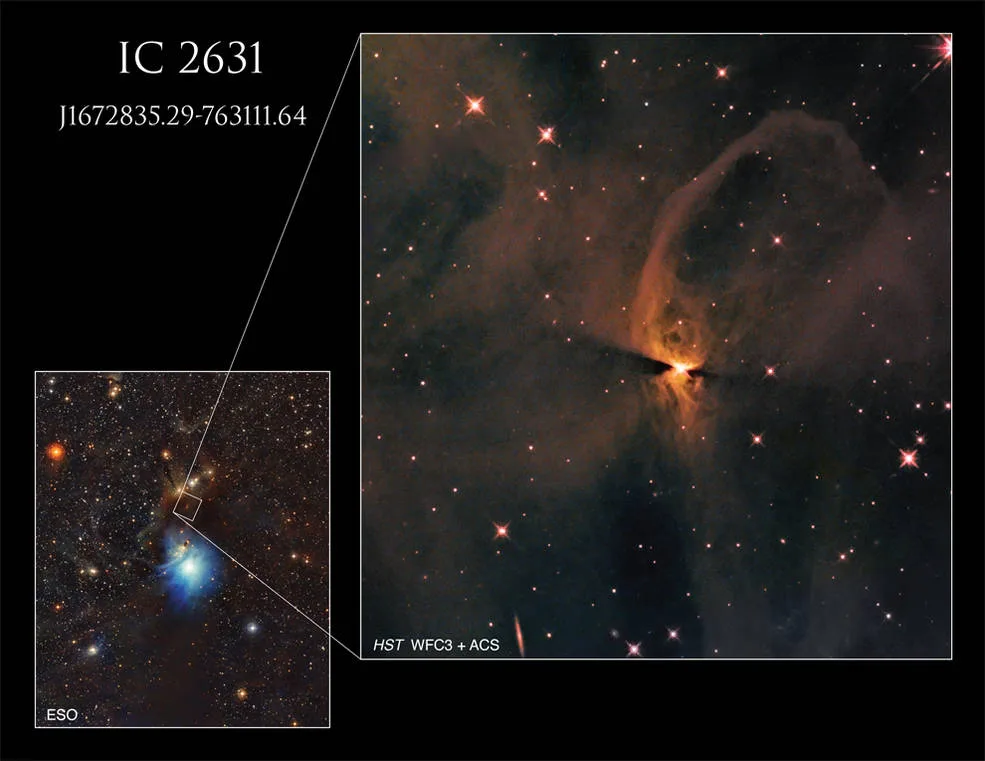
Hubble's sharp eye captures a protostar designated J1672835.29-763111.64 in the reflection nebula IC 2631. Credits: NASA, ESA, T. Megeath (University of Toledo), K. Stapelfeldt (Jet Propulsion Laboratory), and ESO; Processing: Gladys Kober (NASA/Catholic University of America)
It’s part of a more comprehensive effort to understand how stars and planets form and how they’re interconnected. In essence, Hubble remains a key player in advancing our knowledge of the universe, even as newer telescopes come onto the scene. Its enduring contributions to astronomy and space science continue to be invaluable.